Showing posts with label Gst billing in kerala. Show all posts

Thursday, October 25, 2018

Invoicing- Aster Billing

Invoicing

1. All Invoice Settings

Sunday, October 21, 2018

'Tax Year' Aster Billing

WHAT IS A 'Tax Year'

A tax year refers to the 12-month period covered by a particular tax return. The Internal Revenue Service allows some flexibility in determining the start and end dates of a tax year, and it is not necessarily the same period as a fiscal year.BREAKING DOWN 'Tax Year'A tax year is an annual accounting period used by a taxpaying individual or firm for tax purposes. The U.S. Internal Revenue Service (IRS) allows most businesses to use either a calendar year or the firm’s fiscal year as its tax year. Exceptions to this are firms that are required to use the calendar year ending December 31 as their tax year. These include sole proprietorships and single-member LLCs. These firms are required to end their tax year on December 31 because they generally pay taxes as an extension of their single owner.


Friday, October 19, 2018

GST-Concept and Status-Aster Billing

The uniform system of taxation, which, with a few exceptions of no great consequence, takes place in all the different parts of the United Kingdom of Great Britain, leaves the interior commerce of the country, the inland and coasting trade, almost entirely free. The inland trade is almost perfectly free, and the greater part of goods may be carried from one end of the kingdom to the other, without requiring any permit or let-pass, without being subject to question, visit, or examination from the revenue officers. ……This freedom of interior commerce, the effect of uniformity of the system of taxation, is perhaps one of the principal causes of the prosperity of Great Britain; every great country being necessarily the best and most extensive market for the greater part of the productions of its own industry. If the same freedom, in consequence of the same uniformity, could be extended to Ireland and the plantations, both the grandeur of the state and the prosperity of every part of the empire, would probably be still greater than at present”
 Adam Smith in ‘Wealth of Nations’
Whether it was uniformity of taxation and consequent free interior trade orpossession of ‘the jewel in the crown’ at the root of prosperity of Britain isdebatable, nonetheless the words of father of modern economics on the benefitsof uniformity of system of taxation cannot be taken too lightly. Beforeimplementation of Goods and Service Tax (GST), Indian taxation system was afarrago of central, state and local area levies. By subsuming more than a score oftaxes under GST, road to a harmonized system of indirect tax has been pavedmaking India an economic union.

Thursday, October 18, 2018

Filing GST Returns for Your Business- ASTER BILLING

ReturnForTo be filed by 
GSTR 1Outward supplies made by taxpayer (Sales)10th of the next month
GSTR 2Inward supplies received by a taxpayer (Purchases)15th of the next month
GSTR 3Monthly return20th of the next month
GSTR 4Quarterly return for Composite Taxpayer18th of the month next to quarter
GSTR 5Return for Non-Resident Foreign TaxpayerLast day of registration
GSTR 6Return for Input Service Distributor (ISD)15th of the next month
GSTR 7Return for Tax Deducted at Source10th of the next month
GSTR 8Return for e-commerce operator10th of the next month
GSTR 9Annual ReturnBy 31st December of next financial year

Monthly GST Returns Filing

Annual GST Return Filing

Composite Taxpayer and GST Filing

Composite taxpayers will have to file GSTR 4, which will be filed quarterly. The composite tax will be a flat rate of tax, which a business pays based on their turnover in a specific period. They will not be able to take input credits for their purchases. Taxpayers eligible for the composite scheme can opt against the composite scheme and file monthly returns and thereby claim input tax credits on their purchases/supplies as well. Annual return (GSTR-8) will be filed by all normal / regular taxpayers. It will be based on financial records. A compounding taxpayer will also need to file a simple annual return. With GST, though the taxes are getting simplified which is a good for all businesses, there may be an increased burden of compliances on businesses as they have to file a total of 37 returns in year (3 x monthly returns for 12 months; and one return annually) Related Articles: GST Compliance Rating and Why It is Important for YouComposition of Tax Levy Scheme for Small Business in GSTGST Impact on IT and Consultancy Services

Monday, October 15, 2018

Partnership Aster Billing

Partnership

GST Registration - Eligibility, Process and Expert Help Aster Billing

GST is the biggest tax reform in India, tremendously improving ease of doing business and increasing the taxpayer base in India by bringing in millions of small businesses in India. By abolishing and subsuming multiple taxes into a single system, tax complexities would be reduced while tax base is increased substantially. Under the new GST regime, all entities involved in buying or selling goods or providing services or both are required to register for GST. Entities without GST registration would not be allowed to collect GST from a customer or claim input tax credit of GST paid or could be penalised. Further, registration under GST is mandatory once an entity crosses the minimum threshold turnover of starts a new business that is expected to cross the prescribed turnover.As per the GST Council, entities in special category states with an annual turnover of Rs.10 lakhs and above would be required to register under GST. All other entities in rest of India would be required to register for GST if annual turnover exceeds Rs.20 lakhs. There are also various other criteria's, that could make an entity liable for obtaining GST registration - irrespective of annual sales turnover. Entities required to register for GST as per regulations must file for GST application within 30 days from the date on which the entity became liable for registration under GST.IndiaFilings is the leading business services platform in India, offering a variety of services like income tax filing, GST return filing, private limited company registration, trademark filing and more. IndiaFilings can help you obtain GST registration in India and maintain GST compliance through a proprietary GST accounting software. The average time taken to obtain GST Certificate is about 5 - 10 working days, subject to government processing time and client document submission. Get a free consultation on GST and GST return filing by scheduling an appointment with an IndiaFilings Advisor.

How can I track return status that I have submitted after logging to the GST Portal? Aster Billing


Wednesday, October 10, 2018

7 Techniques for Creating Recurring Billing for Any Product or Service -Aster Billing

7 Techniques for Creating Recurring Billing for Any Product or Service 

Aster Billing


Monday, October 8, 2018

FORM GSTR-1 and FORM GSTR-3B Aster Billing

Extension of Due Dates for filing of FORM GSTR-1 and FORM GSTR-3B in certain

In this regard, the due date for furnishing FORM GSTR-1 for the period from July, 2017 to September, 2018 has been extended till 31st October, 2018 for all registered persons having aggregate turnover above Rs 1.5 crores including the registered persons in Kerala, or whose principal place of business is in Kodagu (Karnataka) and Mahe (Puducherry). For taxpayers having aggregate turnover up to Rs 1.5 crores, the due date for furnishing FORM GSTR-1 for the quarters from July, 2017 to September, 2018 has been extended till 31st October, 2018. Notification Nos. 43 and 44/2018 – Central Tax dated 10th September, 2018 have been issued in this regard. For registered persons having aggregate turnover up to Rs 1.5 crores in Kerala, or whose principal place of business is in Kodagu (Karnataka) and Mahe (Puducherry), the due date for furnishing FORM GSTR-1 for the quarter July, 2018 to September, 2018 would continue to remain as 15th November, 2018 as notified vide notification No. 38/2018-Central Tax dated 24th August, 2018.

Sunday, October 7, 2018

Gst Billing Software in kerala - aster billing

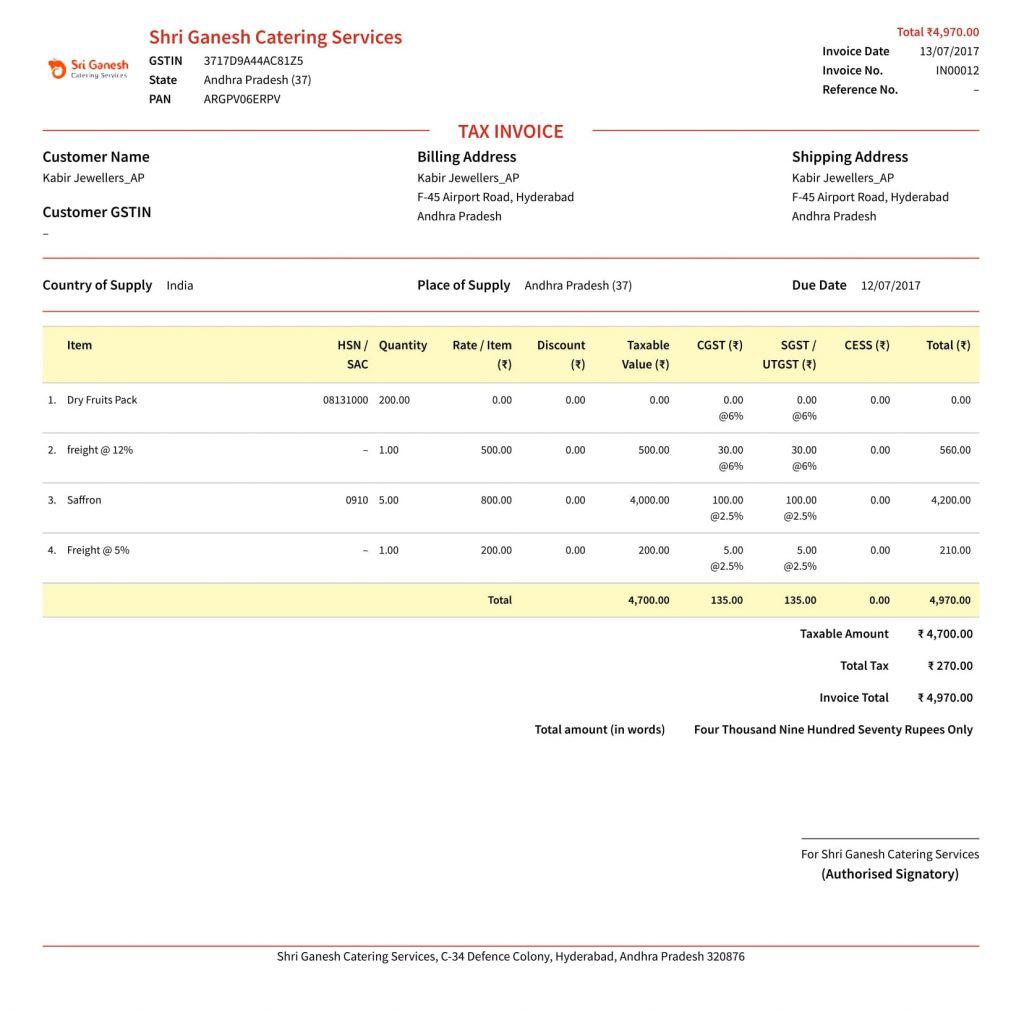
1. What is a GST Invoice?

2. Who should issue GST Invoice?

3. What are the mandatory fields a GST Invoice should have?

  1. Invoice number and date
  2. Customer name
  3. Shipping and billing address
  4. Customer and taxpayer’s GSTIN (if registered)**
  5. Place of supply
  6. HSN code/ SAC code
  7. Item details i.e. description, quantity (number), unit (meter, kg etc.), total value
  8. Taxable value and discounts
  9. Rate and amount of taxes i.e. CGST/ SGST/ IGST
  10. Whether GST is payable on reverse charge basis
  11. Signature of the supplier
GST Invoice example

4. By when should you issue invoices?

GST Invoicing due dates

5. How to personalize GST Invoices?

6. What are other types of invoices?

6.A. Bill of Supply

Invoice-cum-bill of supply

6.B. Aggregate Invoice

6.C. Debit and credit note

debit and credit note
  1. Tax invoice has a lower taxable value than the amount that should have been charged
  2. Tax invoice has a lower tax value than the amount that should have been charged
  1. Tax invoice has a higher taxable value than the amount that should have been charged
  2. Tax invoice has a higher tax value than the amount that should have been charged
  3. Buyer refunds the goods to the supplier
  4. Services are found to be deficient

7. Can you revise invoices issued before GST?

GST revised invoice

8. How many copies of Invoices should be issued?

GST Invoice copies

9. GST Invoicing under Special Cases?